Direct Answer
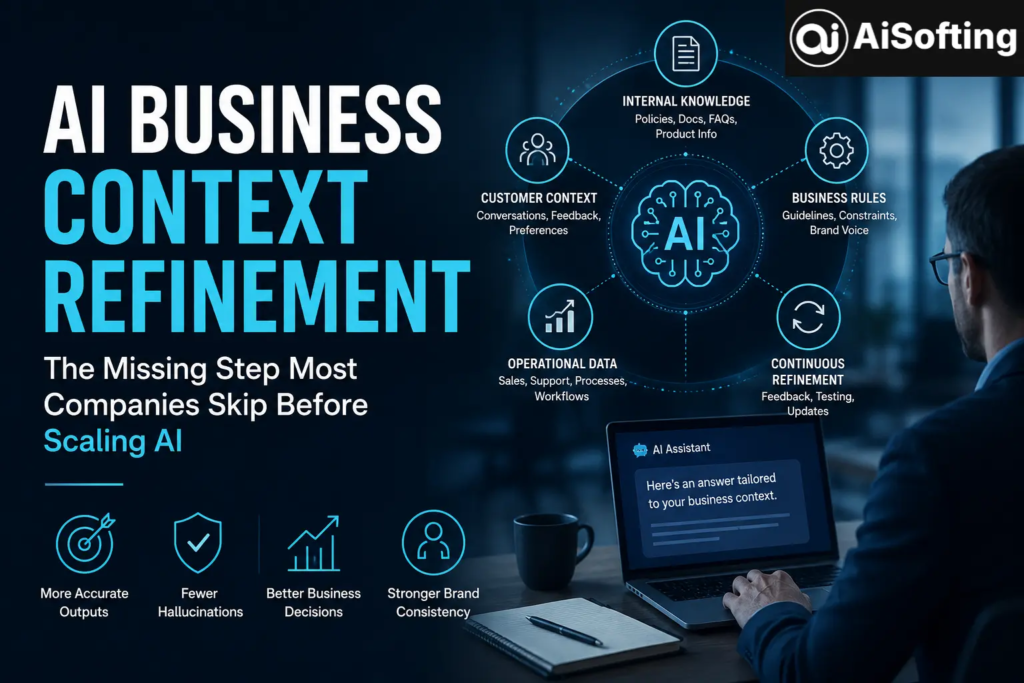
AI governance business context contextual refinement is the process of continuously improving AI governance frameworks so they align with an organization’s unique goals, industry regulations, risk tolerance, and operational workflows. Instead of applying generic AI policies, businesses refine governance practices based on real-world contexts, ensuring AI systems remain transparent, compliant, secure, and effective. Organizations that invest in contextual refinement can reduce AI risks, improve decision-making, and maintain customer trust while adapting to changing regulations and business needs.
What Is AI Governance Business Context Contextual Refinement?
Artificial Intelligence has become a critical part of modern business operations. However, deploying AI without proper governance can lead to compliance issues, biased outcomes, privacy concerns, and reputational damage.
AI governance business context contextual refinement means tailoring AI governance policies according to a company’s:
- Industry requirements
- Business objectives
- Customer expectations
- Risk profile
- Regulatory obligations
- Organizational culture
Rather than using a one-size-fits-all governance model, companies continuously refine policies as their AI systems evolve.
Why Context Matters in AI Governance
Every organization uses AI differently. A healthcare provider handles patient information, while a financial institution processes sensitive financial records. Because of these differences, governance strategies must reflect the specific business environment.
Key benefits include:
- Better regulatory compliance
- Reduced AI bias
- Improved transparency
- Higher customer trust
- More reliable AI decisions
- Lower operational risks
Contextual refinement ensures governance remains practical rather than theoretical.
Core Components of Contextual AI Governance
Business Objectives
Governance should support company goals instead of slowing innovation.
Examples include:
- Faster customer support
- Better fraud detection
- Improved supply chain management
- Personalized marketing
- Predictive maintenance
Policies should help AI deliver measurable business value.
Regulatory Compliance
Different industries follow different regulations.
Examples include:
- GDPR
- HIPAA
- Financial compliance standards
- Consumer privacy laws
- Industry-specific AI regulations
Governance frameworks should adapt whenever regulations change.
Risk Assessment
Businesses should regularly evaluate:
- Data privacy risks
- Cybersecurity threats
- Model hallucinations
- Bias in predictions
- Ethical concerns
- Vendor risks
Continuous refinement helps reduce these risks before they become costly.
Comparison Table: Generic AI Governance vs Contextual Refinement
| Feature | Generic Governance | Contextual Refinement |
|---|---|---|
| Business Alignment | Limited | Highly Customized |
| Compliance | Standard Policies | Industry-Specific |
| Risk Management | Periodic Reviews | Continuous Monitoring |
| AI Transparency | Moderate | High |
| Scalability | Moderate | Excellent |
| Decision Accuracy | Average | Improved |
| Customer Trust | Moderate | Strong |
Why Businesses Need Continuous Governance Refinement
AI changes rapidly.
New models, regulations, cybersecurity threats, and customer expectations emerge every year.
Organizations that review governance only once often fall behind.
Continuous refinement helps organizations:
- Detect new risks
- Improve AI performance
- Update compliance controls
- Monitor ethical concerns
- Strengthen data governance
- Build stakeholder confidence
Governance should evolve alongside AI technologies.
Personal Experience: Lessons from Real AI Projects
From practical experience, organizations often begin AI governance with broad policies copied from industry templates. While these provide a starting point, they rarely address specific operational realities.
We have seen businesses significantly improve AI outcomes after refining governance based on:
- Customer feedback
- Internal audits
- Risk assessments
- Department-specific requirements
For example, a retail company reduced false fraud alerts by refining governance rules around transaction monitoring. Instead of treating every unusual purchase as suspicious, the governance framework incorporated customer purchasing behavior, reducing unnecessary account restrictions while maintaining security.
The biggest lesson is that governance works best when it reflects actual business operations rather than generic documentation.
Case Study: Financial Services Company
A financial services organization introduced AI for loan approvals.
Initially, governance relied on standard AI policies.
Problems included:
- Inconsistent lending decisions
- Poor documentation
- Limited explainability
- Customer complaints
After contextual refinement, the company:
- Added explainable AI requirements.
- Increased human oversight for high-risk decisions.
- Improved bias testing.
- Updated compliance workflows.
- Established regular governance reviews.
Results:
- Faster regulatory reporting
- Improved customer trust
- Better decision consistency
- Reduced compliance risk
This demonstrates how contextual governance directly supports business success.
Best Practices for AI Governance Contextual Refinement
Understand Business Goals
Governance should align with measurable business outcomes instead of acting solely as a compliance exercise.
Establish Clear Accountability
Define responsibilities for:
- Executives
- Data scientists
- Compliance teams
- Legal departments
- Security professionals
Clear ownership improves governance effectiveness.
Improve Data Quality
High-quality data supports:
- Better predictions
- Fair outcomes
- Regulatory compliance
- Reliable reporting
Poor data leads to poor governance.
Monitor AI Continuously
Businesses should monitor:
- Model performance
- Accuracy
- Bias
- Security incidents
- Compliance status
Continuous monitoring enables timely improvements.
Document Everything
Documentation should include:
- Data sources
- Model versions
- Approval processes
- Risk assessments
- Governance decisions
- Audit logs
Good documentation simplifies audits and builds organizational trust.
Common Challenges
Organizations commonly face:
Changing Regulations
AI regulations continue evolving worldwide.
Governance frameworks should be flexible enough to adapt quickly.
Cross-Department Coordination
Legal, IT, compliance, HR, and business teams often have different priorities.
Successful governance requires collaboration across departments.
Legacy Systems
Older infrastructure may not support modern governance requirements.
Businesses often need gradual modernization strategies.
Lack of AI Literacy
Many employees struggle to understand AI risks.
Regular training helps everyone follow governance policies consistently.
Building a Context-Aware Governance Framework
A practical framework typically includes:
Governance Policies
Define ethical principles and operational rules.
Risk Management
Identify and prioritize AI risks.
Human Oversight
Critical decisions should include human review.
Transparency
Explain AI decisions whenever possible.
Continuous Improvement
Review governance regularly using:
- Performance metrics
- Customer feedback
- Compliance findings
- Security reports
- Business objectives
This creates a governance cycle rather than a one-time project.
Future Trends
Businesses should prepare for several emerging governance trends:
- AI-specific regulations
- Automated compliance monitoring
- Responsible AI certifications
- Explainable AI tools
- Governance automation platforms
- Real-time risk detection
- Industry-specific AI standards
Organizations investing today will be better positioned for future regulatory and competitive changes.
Expert Opinion
Governance experts consistently emphasize that successful AI governance is not just about controlling technology—it is about enabling responsible innovation.
Organizations that continuously refine governance according to business context typically experience:
- Higher AI adoption
- Better customer confidence
- Improved compliance readiness
- Lower operational risks
- More sustainable AI growth
Businesses should view governance as a strategic advantage rather than merely a compliance requirement.
Read More: tamildhooms
Pro-Tip
Don’t create AI governance policies once and forget them. Schedule quarterly governance reviews, involve business stakeholders, monitor AI performance continuously, and update policies whenever business goals, regulations, or technologies change. Contextual refinement transforms governance from a static document into a competitive business capability.
FAQs
What is AI governance business context contextual refinement?
It is the continuous process of adapting AI governance policies to match an organization’s unique business environment, regulatory obligations, operational needs, and risk profile.
Why is contextual refinement important for AI governance?
It improves compliance, reduces AI risks, enhances transparency, minimizes bias, and ensures AI supports real business objectives.
How often should businesses refine AI governance?
Most experts recommend reviewing governance at least quarterly or whenever major AI systems, regulations, or business processes change.
Which industries benefit the most from contextual AI governance?
Healthcare, finance, insurance, manufacturing, retail, government, education, and technology companies all benefit because they handle sensitive data and complex regulatory requirements.
What is the biggest challenge in AI governance?
The biggest challenge is balancing innovation with compliance while keeping governance aligned with rapidly evolving AI technologies, regulations, and organizational goals.